 Diatonic Freedom Blocks
Pentatonic scales have five notes. Diatonic scales, like the major and minor scales have seven.
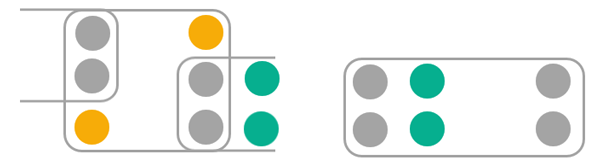
You can easily turn major or minor pentatonic Freedom Blocks into diatonic blocks, by adding two notes to the rectangles. These are the two notes we removed from the major and minor scales to get our five note pentatonic scales.

Rectangles overlap squares on the left and right side. When an extra note is next to a square, you can play that note as part of the diatonic scale.
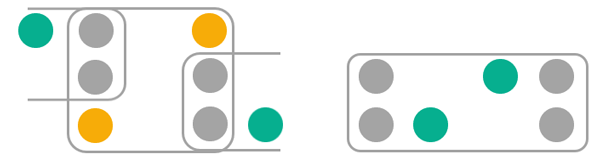
NOTE: It helps if you initially practice these Freedom Blocks separately. Play the square with the outside notes, then practice the rectangle with the inside notes. After a bit of practice combine the two blocks. Below is a C major scale.
(Notation: E5-7-8, A5-7, D5-7, G4-5-7, B5-6-8, E5-7-8)
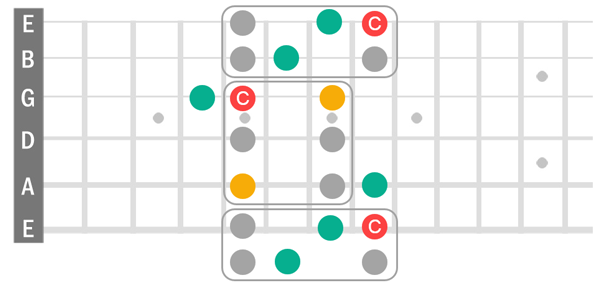
Here is an A minor scale which has the same notes, because it is the relative minor of C major. I've also included green rectangle outlines to help you see where the extra green notes, outside the square, are coming from.
(Notation: E5-7-8, A5-7, D5-7, G4-5-7, B5-6-8, E5-7-8)

Here are the familiar stepping squares. Play this a few times as a warm up.
(Notation: E1-3-5, A 3-5, D3-5-7, G5-7, B6-8-10, E8-10)
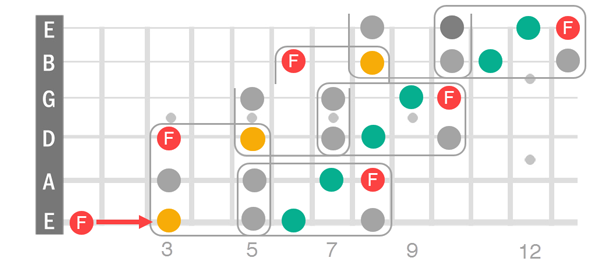
Now add the two extra notes. Use an F major backing track and listen for the difference the two notes make. You don't have to play every note every time.
(Notation, extra notes are bold: E1-3-5-6, A 3-5, D2-3-5-7-8, G5-7,
B5-6-8-10-11, E8-10)

Now try the same F major stepping squares, and add rectangles to the right side of each square. Move between squares and rectangles. Improvise with the extra notes in the rectangles. You don't have to play every green note.
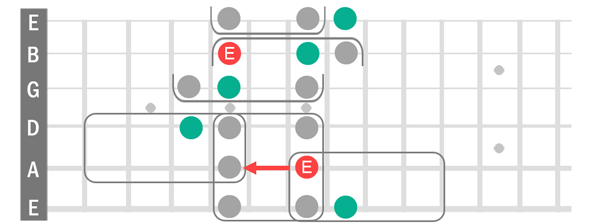
Try this next sequence with an E minor backing track. Compare the pentatonic to the diatonic scale. The extra notes add character and variety to your solo.
(Notation: E5-7-8, A5-7, D4-5-7, G4-5-7, B5-7-8, E5-7-8)
Instead of memorizing a two octave stationary shape, you only need to remember two notes in the rectangles. You can switch in and out of a diatonic scale or use the two extra green notes like seasoning— a sprinkle here and a pinch there.
"If you pick up a guitar and it says, "Take me, I'm yours," then that's the one for you."— Frank Zappa
Modes
The international Morse Code distress signal is S.O.S. In morse code it consist of three short "dits" followed  by three longer "dahs," follow by three short "dits."

If I move the first three dits to the right side, the morse code signal would look and sound totally different.

Scales are like Morse Code. They consist of half-step intervals (1 fret) and whole-step intervals (2 frets). The major scale intervals would look this In Morse Code:

If I moved the first interval of the major scale to the right side, I would get a different looking and sounding scale. This scale is called Dorian mode.

Modes are just the intervals of the major scale arranged in a different order. Like Morse Code, if you rearrange the intervals you get a different sound.
Modes add flavor to our songs. The minor scale is a mode. If we eliminated it, we'd be left with the happy sounding major scale. Songs like Yesterday, Hallelujah, The House of the Rising Sun or Stairway to Heaven would suddenly be happy sounding songs. So modes are a good thing.
You already know two of the seven modes. One mode is the major scale (Take a bow!) and the other is the minor scale. The major scale has five other modes. They each have a different flavor. You might say modes have moods:
1. Ionian (major scale) - "happy"
2. Dorian - "sad but hopeful"
3. Phrygian - "dark and tense"
4. Lydian - "mystical"
5. Mixolydian - "bluesy"
6. Aeolian (minor scale) - "sad"
7. Locrian - "dark"
Modes also have Greek names. The major scale is called Ionian and the minor scale is called Aeolian. You'll want to learn these names, because people use them when discussing modes. (Later I will show you how to pronounce and remember the names.)
Degrees of a Scale
The seven notes of a major scale are referred to as the seven degrees of the scale. So the first degree of a C major scale is C, and the second degree is D and so on.
Intervals of a Scale
Scales also have intervals. The major scale has seven intervals. The first interval of the C major scale is C to D. The second interval is D to E and so on. Below is the C major scale laid out on the fretboard. The orange boxes represent the scale intervals and the notes are the degrees. Intervals and scale degrees are different entities, but closely related.
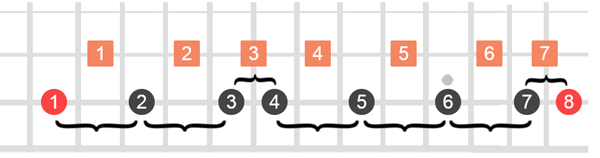
Notice that some of the intervals are two frets wide. These are whole steps. The one fret intervals are called half steps or semi-tones.
In an overly simplified viewpoint, modes are created by rearranging the intervals of the major scale. The chart below shows the starting interval for each mode. The small boxes are the half step intervals, and the wider boxes are the whole steps.
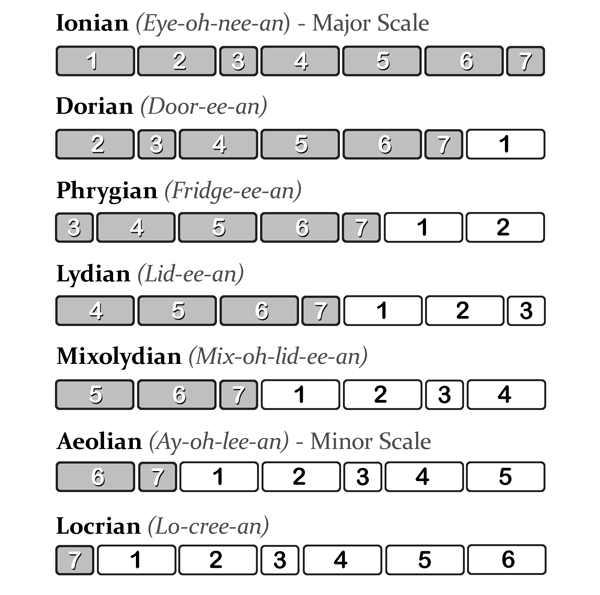
The first set of intervals (1-7) are the major scale or Ionian mode.
w w h w w w h

The 2nd mode, Dorian, starts on the second interval of the major scale.
w h www h w

The 3rd mode, Phrygian, starts on the 3rd interval.
h www h ww

Besides the major scale, the one mode you're very familiar with is the minor scale or Aeolian mode. It starts on the sixth interval of the major scale.
w h ww h ww

All Aeolian scales have this same pattern of intervals. Here is an A minor scale.
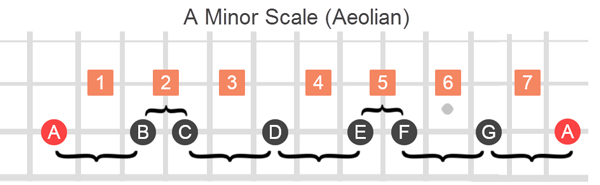
Here is the B minor scale. The order or arrangement of the intervals is the same. All Aeolian scales have that arrangement of intervals.
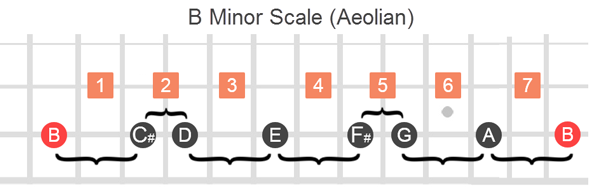
Likewise all major scales (Ionian mode) will have this next arrangement of intervals: ww h www h.
Here are the Ionian, or major scale intervals on the fretboard. Compare this to the previous minor scale illustration.
At this point, we can expand our definition of modes:
- Modes are scales
- Modes have moods
- Modes use the intervals of the major scale
- Modes have unique arrangements of those intervals
- Modes can be major or minor sounding
That last bullet point might be confusing. We already have one minor scale, the Aeolian scale. How can we have additional minor scales that are not Aeolian scales?
Major and Minor Thirds
First let's look at what determines whether a scale is major or minor. It all has to do with the 3rd degree of the scale. If you have a flat 3rd (moved down one fret) you have a minor scale. That flat 3rd is called a minor 3rd. On the other hand, if the 3rd degree of your scale is a not flat, you have a major scale and that 3rd degree is referred to as a major 3rd.
Remember the notes BC and EF are separated by a half step (-). All of the other whole notes are separated by a whole steps (----).
C Ionian mode (Major Scale) and A Aeolian mode (Minor Scale)
In the C major scale the 3rd degree E is 2 whole steps up from the root. That makes E a major 3rd.
C ----D----E-F----G----A----B-C
The relative minor of C is A minor. The 3rd degree of the A minor scale is 1-1/2 step up from the root. That makes C a minor 3rd.
A----B-C----D----E-F----G----A
C Major and A Minor share the same notes and chords. The notes and chords are arranged differently. C Major has a major tonality, while A Minor has a minor tonality.
C Lydian and A Dorian
Now look at a C Lydian (major 3rd) scale. The 3rd degree E is 2 whole steps up from the root. So E is a major 3rd.
C----D----E----F#-G----A----B-C
The relative minor of C Lydian is A Dorian. In the A Dorian scale the 3rd degree is 1-1/2 steps from the root. That makes C a minor 3rd.
A----B-C----D----E----F#-G----A
C Lydian and A Dorian share the same notes and chords. But the notes and chords are arranged differently. Lydian has a major tonality, while Dorian has a minor tonality.
C Mixolydian and A Phrygian
A similar relationship exists between Mixolydian and Phrygian. Here is the C Mixolydian scale. You can see that it has a major 3rd.
C----D----E-F----G----A-Bb----C
The relative minor of C Mixolydian is A Phrygian. Take a look and you'll see that C is a minor 3rd, 1-1/2 steps from the root.
A-Bb----C----D----E-F----G----A
C Mixolydian and A Phrygian share the same notes and chords. But the notes and chords are arranged differently. Mixolydian has a major tonality while Phrygian has a minor tonality.
We could add another bullet point to our mode definition:
- Modes have relative modes
And here are the modes with their relative modes.
- Ionian and Aeolian
- Mixolydian and Phrygian
- Lydian and Dorian
In addition to a mood or flavor a mode may have, it also has a major or a minor tonality:
Major sounding modes: Ionian, Mixolydian and Lydian
Minor sounding modes: Aeolian, Phrygian and Dorian
That leaves the Locrian mode. It does not have a entatonic scale and it doesn't work with Freedom Blocks. It does have a minor 3rd which makes it a minor scale, but it also has a flat 2nd and a flat 5th. Altogether it has a dissonant sound, sometimes called the "devil in music".
Now that you have a pretty good understanding of modes, let's see how easy it is to switch from a pentatonic scale into any of the remaining four modes.
Lydian and Dorian Modes
Lydian, mode four, is a major scale (major 3rd) and Dorian, mode two, is a minor scale (minor 3rd). The extra notes are the same for both modes.
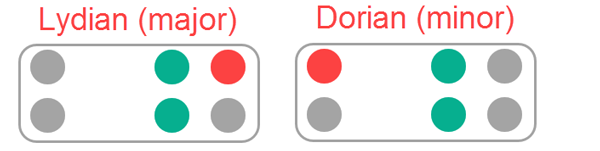
TIP: the extra notes are on the right side of the rectangles, so they'll be on the left side of the squares. Do you know why green notes are never next to orange notes? (Answer: rEcTanGles nEvEer oVerLap oRanGe nOtes.)
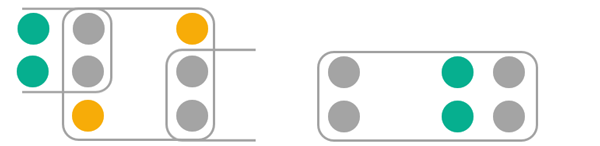
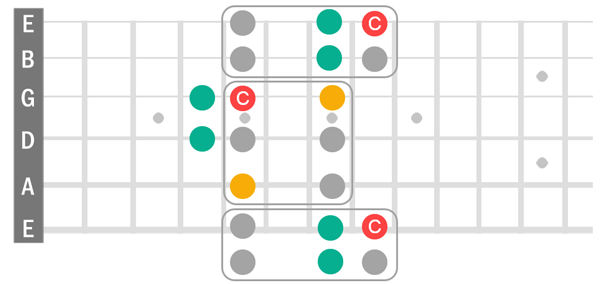
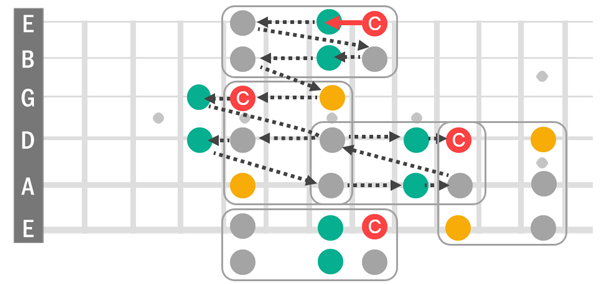
Here is a C Lydian scale with its major 3rd.
(Notation: E5-7-8, A5-7, D4-5-7, G4-5-7, B5-7-8, E5-7-8)
Here is an A Dorian scale with its minor 3rd.
(Notation: E5-7-8, A5-7, D4-5-7, G4-5-7, B5-7-8, E5-7-8)
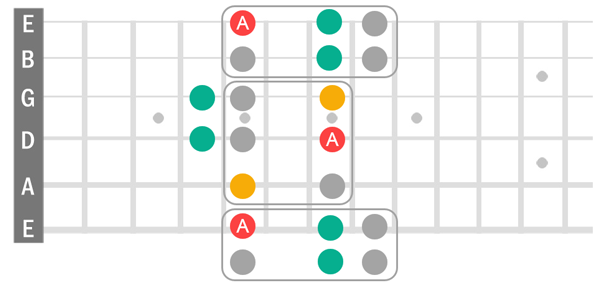
The Lydian and Dorian patterns look very similar. That's because A Dorian is the relative minor of C Lydian. Just like A Aeolian (the minor scale) is the relative minor of C Ionian (the major scale). You might want to read that more than once.
Play this next sequence starting on 8th fret of the high E string. You're playing in a C Lydian major scale.
(Notation: high E8-7-5, B8-7-5, G7-5-4, D7-5-4, A7-9-10,
D7-9-10) Extra notes are in bold.
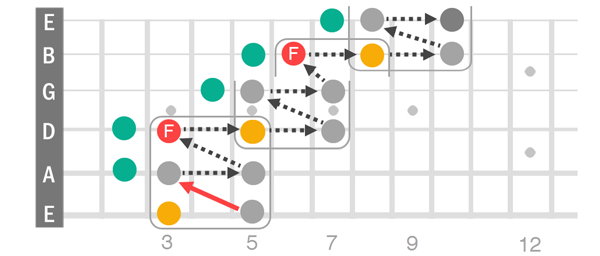
Here are stepping squares with F major Lydian notes.
(Notation: E5, A2-3-5-7, G4-5-7, B string shift, B5-6-8-10,
E7-8-10) Extra Lydian notes are in bold.
Just two more modes to learn.
Mixolydian and Phrygian
Mixolydian, mode five, is a major scale (major 3rd) and Phrygian, mode three, is a minor scale (minor 3rd). Both scales have the same extra notes.
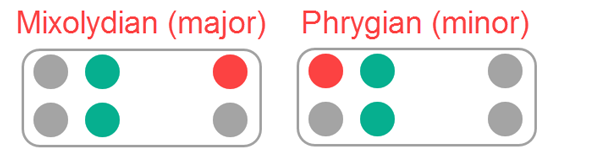
TIP: the extra notes are on the left side of the rectangle, so they'll be on the right side of the squares.
Here is a C Mixolydian scale.
(Notation: E5-6-8, A5-7-8, D5-7-8, G5-7, B5-6-8, E5-6-8)
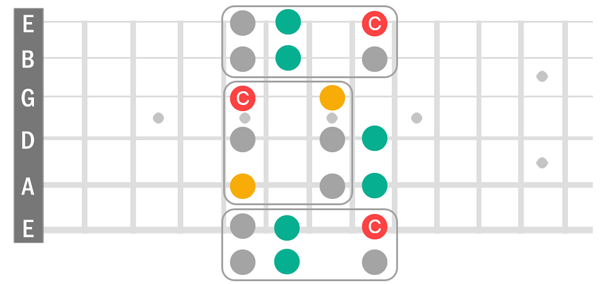
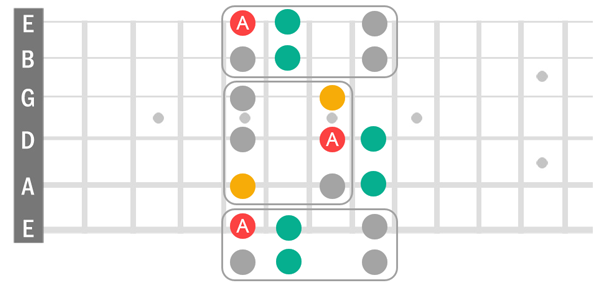
Here is an A Phrygian scale. Once again the scale patterns are similar. A Phrygian is the relative minor of C Mixolydian. They share the same notes, but emphasize different root notes.
(Notation: E5-6-8, A5-7-8, D5-7-8, G5-7, B5-6-8, E5-6-8)
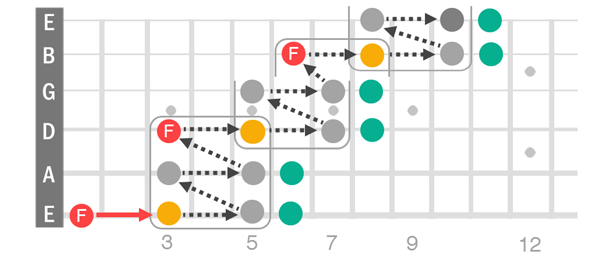
And here are stepping squares with an F Mixolydian scale.
(Notation: E1-3-5-6, A3-5-6, D3-5-7-8, G5-7-8,
B string shift,
B6-8-10-11, E8-10-11) Extra notes are in bold.
The next chart summarizes the diatonic Freedom Blocks. I've left off the 7th mode, Locrian, because it's rarely used. It doesn't have a pentatonic scale and it doesn't fit in the Freedom Block framework. Sorry, Locrian.
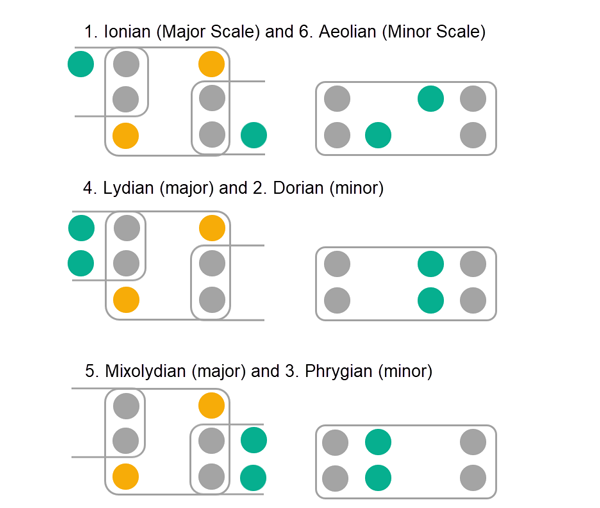
Here is another summary. Remember that Ionian, Lydian, and Mixolydian are major scales. The other scales are minor. I've indicated the major root position with a capital "M" and the minor root position with a lower case "m".
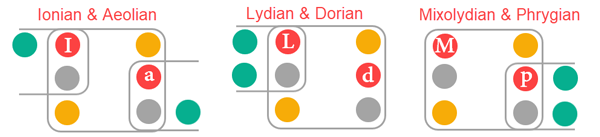
If you'd like to hear the difference between modes, watch this YouTube video by Jake Lizzio or Google: Jake Lizzio demonstrates all 7 modes.
In the Mode for a Quiz?
Guess the mode. Is it major or minor?



Answers: A Aeolian - minor, C Mixolydian - major and G Dorian - minor.
Now try a similar quiz for Freedom Block squares. Guess the mode. Is it major or minor?



Answers: B Lydian - major, D Phrygian - minor, and A Aeolian - minor.
Using Freedom Blocks you can move in any direction, and the two green notes will follow along. You can instantly switch between diatonic and pentatonic scales, or switch to a different mode of the major scale.
Relative minors and majors give you more options when soloing. If you're improvising with a C major song, you can use these four scales:
- C major pentatonic
- A minor pentatonic
- C major diatonic
- A minor diatonic
"In other words, when we have a major tonality, we can think in two scales: the major scale of this tonality and the relative minor scale of it. This increases our options when we are thinking in solo."—Source: SimplifyingTheory.com