Major Pentatonic Scale
Major vs. Minor Freedom Blocks
What makes one pair of Freedom Blocks sound major or minor is the interval between the root note and the 3rd degree of the scale. In a major scale the 3rd degree is four frets away from the root. In a minor scale the 3rd degree is a flat 3rd. That moves it one fret closer to the root.
Major and minor chords have the same relationship with the 3rd degree of their scales. The only difference between the two chords below is the flat 3rd in the minor chord.

The major pentatonic scale removes the 4th and 7th notes of the major scale. That leave two wide intervals (rectangles) and three narrow intervals (squares). It's a major scale so it has a major 3rd.
(Major Scale Notation: E1-3-5-6-8-10-12-13)
(Major Pentatonic Scale Notation: E1-3-5-8-10-13)
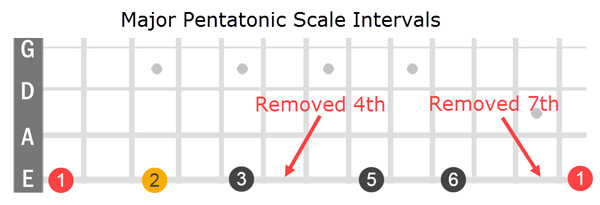
Here's how those intervals fit into the major pentatonic Freedom Blocks.

Even though the notes are different, major and minor Freedom Blocks work the same. The only visible difference is the position of the root notes.

That changes where the root notes appear in the rectangles.

Starting on the same root note your can play a major or minor pentatonic scale. The Freedom Blocks look similar except for where the root notes are located..
(Major Notation: E5, A2-4. D2-4. G2-4. shift B2-5, E2-5)
(Minor Notation: E5-8, A5-7, D5-7, G5-7, shift B5-8, E5-8)

Here is the A minor sequence you played for your first solo.

Starting from the same root note, play these stepping squares in the key of A major. You might get lost because you're so use to playing the minor version. Try adding a slide in the first row of each square.

 Everything you've learned about minor Freedom Blocks applies to major Freedom Blocks. It's like taking a Spanish class and at the end of the semester your instructor announces that you've also learned to speak French.
Find a major key backing track and give your new found skill a test run. You can start on any root not. Be sure to keep an eye out for the B string.
Shapeless But Not Clueless
Once you understand major or minor Freedom Blocks, all you need is a root note.
(Location of A roots: E5, A0-12, D7, G2-14, B10, E5)
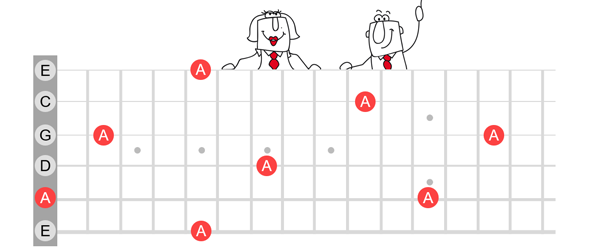
You're sitting on root note in the key of A major pentatonic. You're ready to move.

Move to the left and you're in a rectangle heading to another square. Move to the right and improvising in a square. It's that simple.

As always you're free to move in whatever direction the groove takes you. That's what Freedom Blocks are all about.

Adding Licks to Your Solo
A lick is a short sequence of notes that sound musical. You can find hundreds of licks online and incorporate them into your improvisation. Here's an example of a lick.
(Notation: A3-6, D3-5, G3-5, B string shift, B4-6-4-6, E3-6)

Licks are usually presented in tabs. The numbers are the frets, the lines are the guitar strings and zero indicates an open string. Tabs are easy to play but hard to remember.
You need a way to get the lick into your memory in a format that's instantly retrievable, like remembering a person's face. Here is a 13-digit number that's difficult to memorize.
8453230200699
If I make a small change to the number, it's easier to remember:
At 8:45 call 323-0200 and pay $6.99 for chocolate donuts.
Our brains love structures like time, phone numbers and prices. It's like your brain has special places set aside for each of these structures.
By now your brain has a place for Freedom Blocks. If I tell you that I'm on the third row of square and stepping up to the next square. Your brain instantly has a picture of what I'm doing. You can literally juggle Freedom Blocks in your head.

Converting Tabs to Freedom Blocks
To remember a lick, you have to convert it to a Freedom Block picture. Start by playing the lick and looking for consecutive narrow and wide intervals. The narrow intervals are squares; the wide intervals are rectangles. Most licks use the major or minor pentatonic scales, so you'll only be dealing with those two types of intervals.
Once you get a picture of the Freedom Blocks, you can focus on what's happening inside those blocks. You're looking for a "gold nugget". It could be a repeating pattern, a series of hammer-ons or bends, a double stop or a series of pull offs. Whatever it is that makes that lick interesting and memorable.
If you run into a note that doesn't fit into a square or rectangle, it could be the blues note, or a chromatic walk up. Play this next lick and see if your brain recognizes the structure. Remember to allow for the B string shift.
(Notation: G7-8-9, B8-10, E8-10-11-10-8, B10)

It's a Freedom Block square with a blues note and a B string shift. Here's the picture you want in your brain.

As soon as your brain makes the Freedom Block connection, you can instantly play the lick in any major or minor key and move it to different strings without taking a second look at the tabs. Here's the same lick picture starting on the 5th fret of the A string.
(Notation: A5-6-7, D5-7, G5-7-8)

Once you have the picture, you can experiment and add your own embellishments.
Try finding the Freedom Blocks in this next lick.
(Notation: G7, E5, B5-8, E5, B5, E8-5, B5-8, E5, B5)

The first two notes don't give us a clue, but the next two notes are clearly a wide interval on the B string. Moving along, you'll find another wide interval on the E string. So you've got a rectangle sitting on the B and E strings. The 7th fret note is part of a square, because you alternative from rectangle to square when stacking Freedom Blocks.
That's a lot of words to describe the following image. Once you see the underlying blocks you can easily move to a different key or a different group of strings.

Many licks have less than six notes. That doesn't give you a lot of clues. Treat licks like puzzles and yYou'll be amazed at how quickly the Freedom Block picture comes into focus.

The first interval, B10 and B8, is narrow so it's part of a square. The G note shifted down from G10 to G9 after leaving the B string. The entire lick is played in rows one and two of a square.

In this next lick, you'll slide from the 7th fret to the 9th fret.
(Notation: G5-7 slide 9, B8-10, E8-11-8)

First, you're moving over two narrow intervals (5-7 and 7-9) on one string. Can you remember when you've done this move many times, perhaps with a slide?

It happens when you're on row three of a square( G5-7) and you're moving to row one of the next stepping square (G7-9)
The interval on the E string should be the third row, but instead of 8 to 10 we have 8 to 11, a wide interval. The note on the 11th fret is a blues note from row one of the next stepping square. It sounds complicated, but loses its complexity once you see the Freedom Blocks.

Many times I've transcribed a lick from tabs to Freedom Blocks only to realize that I already know the lick. In fact, the previous lick was part of your first solo exercises.

The next lick has three wide intervals. Play it and figure what is going on in that wide interval on the G string.
(Notation: e5-8-5, B8-5, G5-8-7-5)

Once you see the Freedom Block structure you're no longer confined to the tab sequence. As airline pilots say, "You're free to move about."
Finding the Root of a Lick
Many of the licks you find online do not give you the key or root note. People suggest writing out the notes, looking for sharps and flats and cross-referencing that information with the circle of fifths. Sounds complicated.
On the other hand, if you're able to identify at least one Freedom Block in a lick, you can narrow the number of possible keys from 24 to 2. In the example below, the key is either C major or A minor.

Which do you use? Well, it depends, but my first choice would be the minor key. You can't go too wrong no matter which one you choose, because A minor is the relative minor of C so they share the same notes. More about that later.
Open String Licks

Roger Miller was talking about the first three frets of the guitar. Part of the appeal is you don't have to fret the open strings and they sound great. Try these next sequences in the key of G or the relative minor Em. The open strings make it easy to move around.
(Notation Key of G: E3, A0-2, D0-2, G0-2, B0-3, E0-3)
(Notation Key of Em: E0-3, A0-2, D0-2, G0-2, B0-3, E0-3)

Here are licks using the open strings.
(Notation: E3, A0-1-2, D0-2-0, G0, D2-0, A1-0, E3)
Next lick starts on your high E string.
(Notation: e0, B3-0, G3-2-0, D0-2, G0, D2-0, A0-2, D0, A1-0, E3)
Try mixing chords with your open strings solo. If you know a G major or E minor chord, strum one and periodically launch into a short solo using the open strings.
