Freedom Block Rectangles
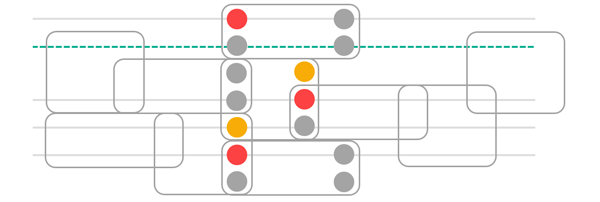
Rectangles are parasites. They lack notes of their own, so they latch onto squares and bridge the gap between them. In other words, they overlap squares.
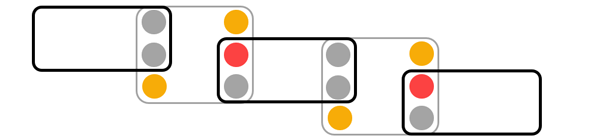
Rectangles never overlap orange corner notes. If they did the notes would turn into pumpkins.

Remember IN on the TOP and OUT on the BOTTOM as you move to the right.

Play inside each of the squares below and use the rectangle bridge to jump between them.
(Notation: A5-7, D5-7-10-12, A12-10-7-5-7, D5-7)

Let's add another rectangle. ( New rectangle's notes are D5-2, G5-2)
(Notation continued: D7-5-2, G5-2)

Rectangles and squares alternate. Let's add a square using open strings.
(New square: D2-0, G2-0, B string shift B3-1) (Notation continued: G2-0, D2, B1, G2)

Rectangles Crossing the B string
As a rectangle crosses over the B string row 2 shifts up one fret. If both rows land on the B and E strings, the entire rectangle shifts up one fret.

In the next example, the top rectangle lands on the B and E strings, so it shifts up one fret.
(Notation: E3-6, A3-6, D5-8, G5-8, B string shift, B8-11, E8-11)

Next, only row 2 lands on the B string.
(Notation: E5-8, A7-10, D7-10, G9-12, B10-13, E12-15)
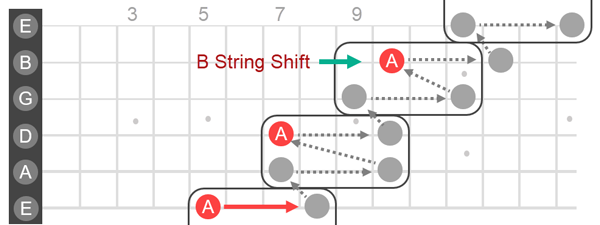
Let's slide into our stepping rectangles using the first rows of adjacent squares.
(Notation: E3 slide E5-8, A5-8, D5 slide D7-10, G7-10, B shift, B6 slide B10-13, e10-13)
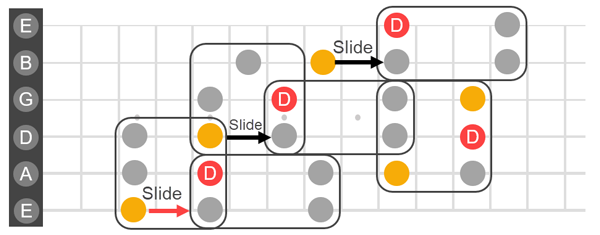
Below I removed the rectangle in the center of the previous illustration. It reveals a new property of Freedom Blocks: you can stack them.
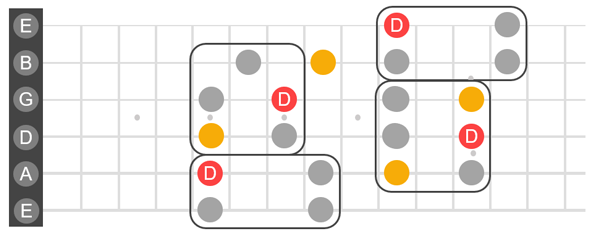
Stacking Freedom Blocks
When you stack Freedom Blocks, you alternate between squares and rectangles. The blocks do not overlap. Here's the first stepping square sequence you learned. I've added rectangles above and below the square.

The rectangle on the B and E strings is shifted up one fret causing all three Freedom Blocks to line up on the left side. This alignment might explain why this is the most famous guitar shape. If you hear a YouTuber say, "We're going to use shape one, or box one." This is the one.
Play the sequence in both directions. Try using your "pinky" or little finger, to reach the wide intervals.
(Notation: E5-8, A5-7, D5-7, G5-7, B5-8, E5-8)

Let's add rectangle notes to our original stepping square pattern. Play the wide interval in the rectangle with your first and third finger, first and pinky finger, or you can slide from one note to the next.
(Notation: E5, A3-5-7, D5-7, G5-7, B5-8-10, E8-10-12)

Let's reverse our sequence using a different route back to the root note. Start on the 12th fret of the high E string. Notice that the rectangle shares its right-side notes with the square.
(Notation: E12-10-8-5, B8-5, G7-5, D7-5, A7-5-3, E5)

Time to Solo
Here is the same pattern with blues notes. Turn on your A minor backing track. Play up and down while adding the blues and rectangle notes. You can play the flat 3rd on the A or E string. Also notice the blues note on B4. Rectangles overlap squares. The blues note is in row 1 of every square.
(Scale pattern per string: E5-8, A3-5-6-7, D5-7, G5-7-8-9, B5-8-9, E5-8-10-11-12)

All of our examples so far have used the A minor pentatonic scale. Below, I've moved the Freedom Blocks up two frets for an B minor scale. Find a B minor backing track and give this a try.
(Notation: E7-10, A7-8-9, D7-9, G7-9-10-11, B string shift, B10-12, E10-7, B10-7-6-5, G3-5)

Freedom Blocks let you start on any string. In this next example we're in the key of C minor starting on the 3rd fret of the A string. You can also play row one of the rectangle on the low E string.
(Notation: E3-6, A3-6, D3-4-5, G3-5, B string shift, B4-6, E3-6)

You can use my flag and chair analogy to line up squares and rectangles. When you move to a higher string fly high, and when you move to a lower string sit down.

My analogy doesn't work when the first row of a square or rectangle lands on the B string. In those two cases, the entire Freedom Block moves up one fret.
(Notation rectangle: E2-5, A2-4, D2-4, G2-4, shift, B2-5, E2-5)
(Notation square: E9-11, A9-11, D8-11, G8-11, shift, B9-11, E9-11)

—David Edwards
So don't fret about it.
Vertical Improvisation
Here is the G minor pentatonic scale, starting on the 3rd fret (G) of the low E string. The minor pentatonic scale has two wide intervals (rectangle) and three narrow intervals (square). Try playing this scale on the low E string.
(Notation: E3-6-8-10-13-15)

Next we'll overlay the Freedom Blocks on the scale intervals. Notice that the first two intervals are the top row of a rectangle and a square. The next two intervals start on row one of a square and a rectangle. The last interval starts in the middle or row two of a square.
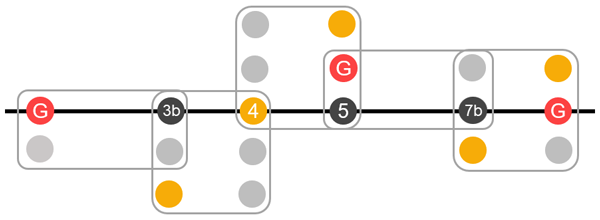
Here are the intervals we are using for the G minor pentatonic scale.
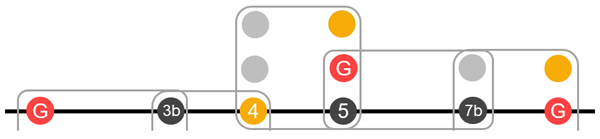
Next we'll take each interval and move vertically to the high E string using Freedom Blocks. Turn on a G minor backing track and be sure to practice in both directions.
First Interval
The first interval starts on row 2 of a rectangle. You'll immediately rotate to a square, followed by a rectangle. Both rows of the rectangle shift up one fret. This is the most famous shape among lead guitar players.
(Notation: E3-6, A3-5, D3-5, G3-5, B string shift, B3-6, E3-6)
Second Interval
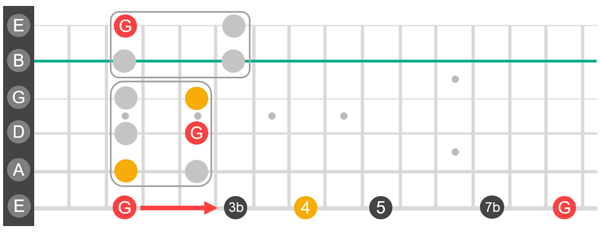
The second interval is row 2 of a square. Play those two notes, then rotate to a rectangle on the A and D strings. After the rectangle, rotate to a square and make the B string shift.
(Notation: E6-8, A5-8, D5-8, G5-7, B string shift, B6-8, E6-8)
Third Interval
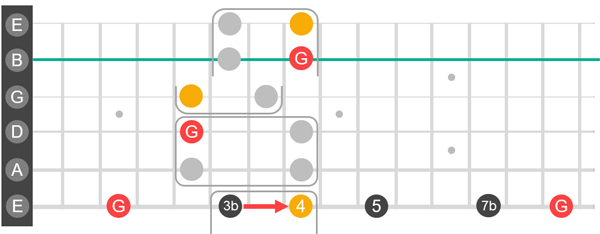
The third interval starts on row 1 of a square. After completing the square you switch to a rectangle. Row 2 of the rectangle and row 1 of a square get shifted up one fret on the B and E strings.
(Notation: E8-10, A8-10, D8-10, G7-10, B string shift, B8-11, E8-10)
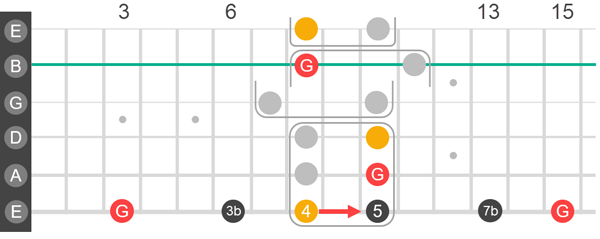
Fourth Interval
The fourth interval is row 1 of a rectangle. Complete the rectangle on the A string, then rotate to a square. Row 3 of the square shifts up one fret on the B string. Row 1 of the next rectangle maintains its relative position, aligning on the right side.
(Notation: E10-13, A10-13, D10-12, G10-12, B11-13, E10-13)
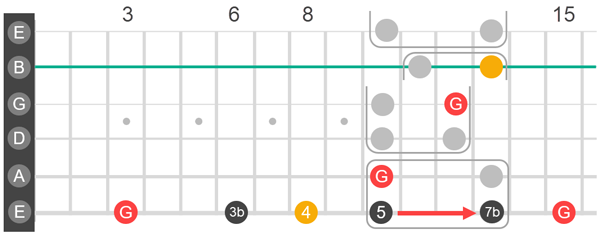
Fifth Interval
The fifth interval is row two of a square. Complete the square on the A string, then rotate to a rectangle. Finish with rows one and two of a square shifted up one fret.
(Notation: E13-15, A13-15, D12-15, G12-15, B13-15, E13-15)
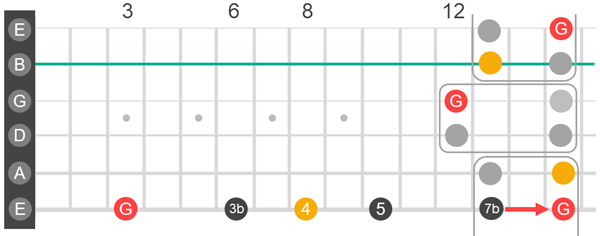
Can you figure out why we these two stacks look the same?
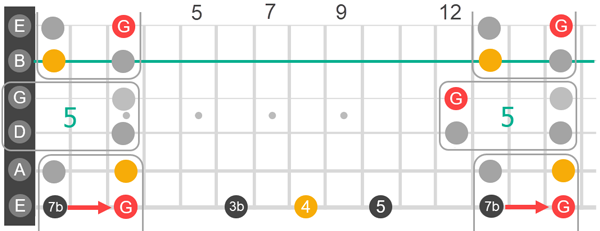
That completes all five intervals of the G minor scale. You have just played every note in the G minor pentatonic scale up to 15th fret using stacked Freedom Blocks. Congratulations!
CAGED System
The previous five shapes are famous. They're the five shapes of the CAGED system. This system was introduced in the 70's to help people play scale tones on the fretboard. As you can see it relies on vertical stacking. The main criticism of the CAGED system is its "boxy" sound, as players spend too much time in one shape or they're unable to move smoothly between shapes.
Freedom Blocks help break out of the "box" and achieve a balance between vertical and horizontal playing.
Shapeless But Not Clueless
Once you understand Freedom Blocks, all you need is a root note.
(Location of A roots: E5, A0-12, D7, G2-14, B10, E5) (Key: A minor pentatonic)
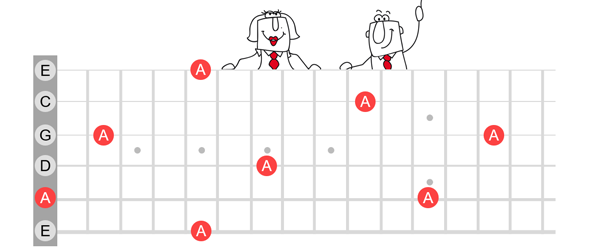
Once you're sitting on root note in the key of A minor pentatonic, you're ready to move.

If you move left, you're in a square; if you move right, you're in a rectangle heading for another square. It's that simple.

You can move about using stepping squares, overlapping rectangles, side-steps and stacking blocks. Let the groove be your guide and keep an eye out for the B string.
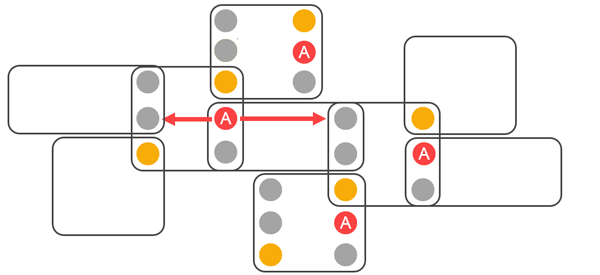
From a distance Freedom Blocks can look like a traffic jam, but that's not your viewpoint.
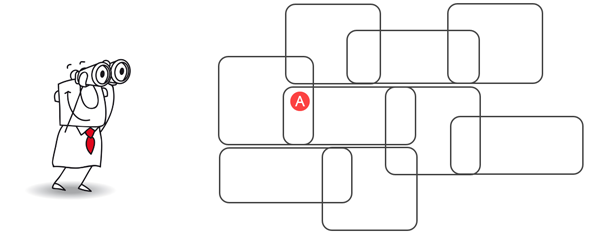
Instead you're sitting in one square or rectangle, deciding which direction you want to go, and jamming as you move on out the "fretway".
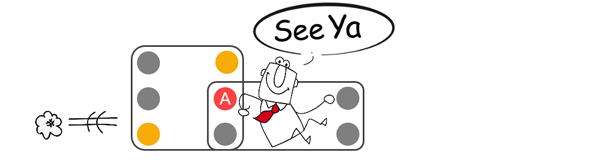
He didn't say that, but you get the idea.
Solo Inspiration
Scale are a good starting point, but once a backing track starts, it's time to get creative. You can repeat notes, go up three notes and back two, repeat a series of three or four notes, slide, bend, slow down and speed up. Ian at Stichmethod.com suggest watching Gen Kelly dancing in the movie, Singin' in the Rain, for inspiration on soloing.